
When Do Pipes Freeze in Asheville? (Hint: It’s Not 32 Degrees)
Everyone knows water freezes at 32 degrees. But after 20 years of plumbing in Asheville, I can tell you that one cold night is rarely what freezes your pipes.
The issues start when it stays cold through the night, then all the next day, and never climbs above 32. And in WNC, when we string a few of those days together, our phones start to ring off the hook.
A few years ago, Western North Carolina had a stretch of four days that never got above freezing. On the last morning, we took more than 200 calls before lunch.
Wind Makes It Worse
Wind pushes cold air into every gap in your house and pulls the heat off any pipe it touches, so when we add wind to a multi-day freeze and the risk jumps.
So be aware, especially if you have a home up on a hill, with little tree cover as those will take the full force of wind coming up the valley.
Where pipes freeze in Asheville homes
- Crawl spaces. This is number one. Open foundation vents, gaps in the foundation, or a poorly sealed crawl space door let cold wind blow right across your water lines.
- Exterior walls. Pipes running inside outside walls are exposed. We avoid running water lines in exterior walls for exactly this reason.
- Attics. If you have water lines in your attic, that’s a real problem. Attics get nearly as cold as outside.
Not sure if one of your sinks is on an exterior wall? Open the cabinet underneath. If the water line comes out of the wall, it’s likely that they’re running up that outside wall. If they come up through the floor, you’re likely fine.
If you’ve lived in your home for at least a year, you probably already know your problem spots, so trust that!
Should You Drip Your Faucets?
Yes, on your problem faucets, but be sure to drip both hot and cold.
This surprises people, but in our years of experience the hot line almost always freezes first. When we show up to a frozen pipe call, it’s usually the hot side that’s stopped. So don’t just crack the cold.
How much should you drip? On a really cold night, let it run to almost a thin, steady stream, not just an occasional drip. Moving water keeps bringing in fresh water from underground lines which stay above the freezing point. That warmer water keeps the pipe from icing up.
The colder it gets, the more water you need moving. A slow drip that works at 28 degrees may not be enough at 10.
Take Your Hoses Off the Outdoor Faucets
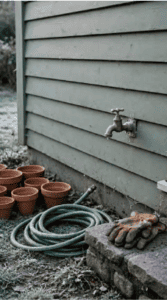
This is the easiest fix on the list, and the one people forget most.
Most newer homes have frost-proof outdoor faucets. They actually shut the water off back inside the wall, in heated space, and the rest drains out when you close them. That feature only works if the water can drain.
Leave a hose attached and it traps water in the faucet. That water freezes, expands, and splits the pipe, which is exactly what happens in any frozen pipe.
The worst part: you won’t know until spring. The first time you turn on the hose, water starts leaking inside your wall.
What to Do If Your Pipes Are Already Frozen
Heat the space, not just the pipe.
If you have copper pipe, heating the pipe itself can work because copper heats quickly. But most modern homes use plastic pipe like PEX, and heating one spot on plastic barely does anything, and you’ll be there all day.
Instead, put a space heater where the cold is and warm the whole area. If a wellhead is frozen, a small heat lamp works well.
Here’s what our techs do on a frozen pipe call:
- Find the coldest spot in the house and figure out where water isn’t flowing.
- Heat that space. In a crawl space, we set a heater at the door and pump warm air in.
- Open the faucets and watch. It usually takes 10 to 15 minutes before water starts moving.
- Keep the faucets open. Once water flows, it helps thaw the rest of the line on its own.
Never use a torch or open flame, because heating a frozen pipe too fast can make it burst.
After the Thaw: Check for Leaks
A pipe can freeze, crack, and look fine until it thaws, but then the water starts pouring out. Once things are flowing again, check your whole system.
How bad the possible damage really depends on the pipe in your home:
- PEX (flexible plastic): Has some give. If you thaw it quickly, it often survives without bursting.
- Copper: Gets small “eyeball” splits, about an inch or two long.
- CPVC (rigid plastic): Tends to shatter or split down its length, so whole sections need replacing.
To check for a leak:
- Shut off every faucet and make sure no toilets are refilling. Then walk the house and listen for running water.
- Look at your water meter. Many newer meters have an indicator that shows when water is flowing.
- On a well, watch the pressure gauge. If it slowly creeps down with everything off, you have a leak somewhere.
If you find a leak, shut off the main water valve and call a plumber. Anything on the house side of the water meter is the homeowner’s responsibility.
Fix It on Your Schedule, Not Mother Nature’s
If your pipes freeze every winter, something in the house needs fixing.
I once worked on a newer home in Fairview that sat up on a hill. The wind came up through the valley and hit one side of the house all winter, and the homeowner kept getting frozen pipes on that side. We insulated the exposed lines and moved a few away from the foundation vents and crawl space door. We closed the vents and insulated the door. She hasn’t had a frozen pipe since.
That’s the kind of problem worth solving before the next cold snap.
Our Service Partner Plan makes this easy:
- No emergency fees on nights and weekends, so a frozen pipe at 2 a.m. doesn’t cost extra.
- Priority service when the phones are ringing off the hook.
- A full home inspection report that shows the weak spots in your plumbing, including the ones most likely to freeze.
Worried about this winter? Have one of our plumbers go through your home now. We’ll find your weak points and help you fix them on your time, instead of letting Mother Nature decide when you spend the money.
Call Four Seasons Plumbing at 828-222-4117 or visit
https://callfourseasons.com/about-us/maintenance-plan/ to sign up for the Service Partner Plan.